
China and Japan in One Trip: The Smart Way to Combine Both Countries in 2026-2027

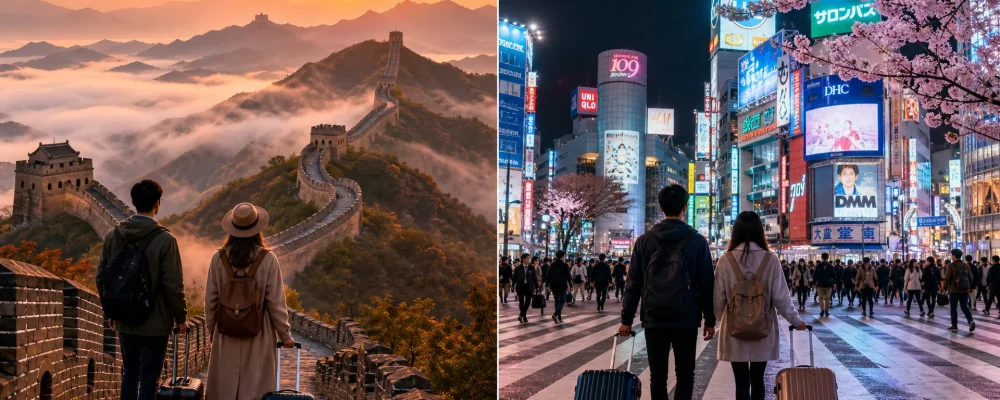
"Split-screen comparison of Great Wall of China and Tokyo Shibuya neon crossing for combined Asia trip planning"

You want to do Asia. Both countries. In one trip. The question isn’t whether it’s possible (it is), but whether it makes sense (sometimes), and if so, how to do it without exhausting yourself to the point of hating both countries.

I’m going to walk you through the logistics, the realistic timelines, and the combinations that actually work instead of just stacking days onto a map and hoping for the best.

Should You Actually Combine China and Japan? (The Honest Answer)

Before we get to itineraries, let’s talk about whether combining these two countries is worth it.

Go for it if:

  • You have 14-18 days minimum
  • You’re interested in contrasting cultures (ancient vs. modern, chaotic vs. organized, accessible vs. refined)
  • You don’t mind flights between countries
  • You can handle different paces, food systems, and language barriers
  • You want to maximize geography without returning home between trips

Skip the combo if:

  • You have less than 12 days (stick to one country)
  • You prefer deep exploration over breadth (choose one country and stay longer)
  • You get overstimulated by constant change and new environments
  • Your budget is tight (combining countries means flights between them)
  • You want to relax (this combo is go-go-go pacing)

Real talk: The best China and Japan trips stick primarily to one country and visit the other briefly, not a 50-50 split.


The Three Smart Combinations

Combination 1: China Heavy, Japan Light (Recommended for First-Timers)

Duration: 14-16 days total

The logic: China requires 8-10 days minimum to feel less rushed. Japan can work as a 4-5 day final chapter without feeling incomplete.

Itinerary:

 

China Multi-city Tour: Must-see Cities & Hidden Highlights (2026)

China (Days 1-10):

Japan (Days 11-15):

Why this works: You get the full China experience without rushing, then Japan feels like a cherry on top. No major logistics headaches. High cultural contrast without cognitive overload.

Budget estimate: $3,500-5,000 per person (tours, flights, accommodation, food)

Best for: Families, first-time Asia travelers, people who prefer structure

Combination 2: Balanced Split (For the Energetic)

Duration: 16-18 days total

The logic: Both countries get 7-8 days of real time. More fulfilling if you care about Japan equally with China.

Itinerary:

China (Days 1-8):

  • Days 1-3: Beijing (Great Wall day trip included)
  • Days 4-5: Train to Chengdu, pandas
  • Days 6-8: Train to Shanghai
  • Flight Shanghai to Tokyo (Day 8-9, red-eye)

Japan (Days 9-16):

  • Days 9-10: Tokyo
  • Days 11-13: Kyoto/Nara via bullet train
  • Day 14: Osaka
  • Days 15-16: Return to Tokyo, final rest before departure

Why this works: Both countries feel substantially explored. You hit the major highlights without completely compromising depth. Bullet trains in both countries mean efficient city-to-city movement.

Budget estimate: $4,500-6,500 per person

Best for: Repeat Asia travelers, people with 2-3 weeks PTO, culture enthusiasts

Combination 3: Japan Heavy, China Light (For Japan Obsessives)

Duration: 14-16 days total

The logic: Japan gets the substantial time, China is the opener or closer.

Itinerary:

China (Days 1-4):

  • 4 days Beijing (or Shanghai for modern contrast)
  • Flight Beijing to Tokyo (Day 4-5, overnight)

Japan (Days 5-14):

  • Days 5-6: Tokyo
  • Days 7-9: Kyoto/Arashiyama/Bamboo Grove
  • Days 10-11: Osaka and Kobe
  • Days 12-14: Return to Tokyo, rest, explore deeper neighborhoods

Why this works: Japan stays your priority (7+ days), China is the context (showing you Asia’s diversity), no rushing in Japan.

Budget estimate: $4,000-5,500 per person

Best for: Japan specialists, people with limited time but Japan obsession, second-time Asia visitors
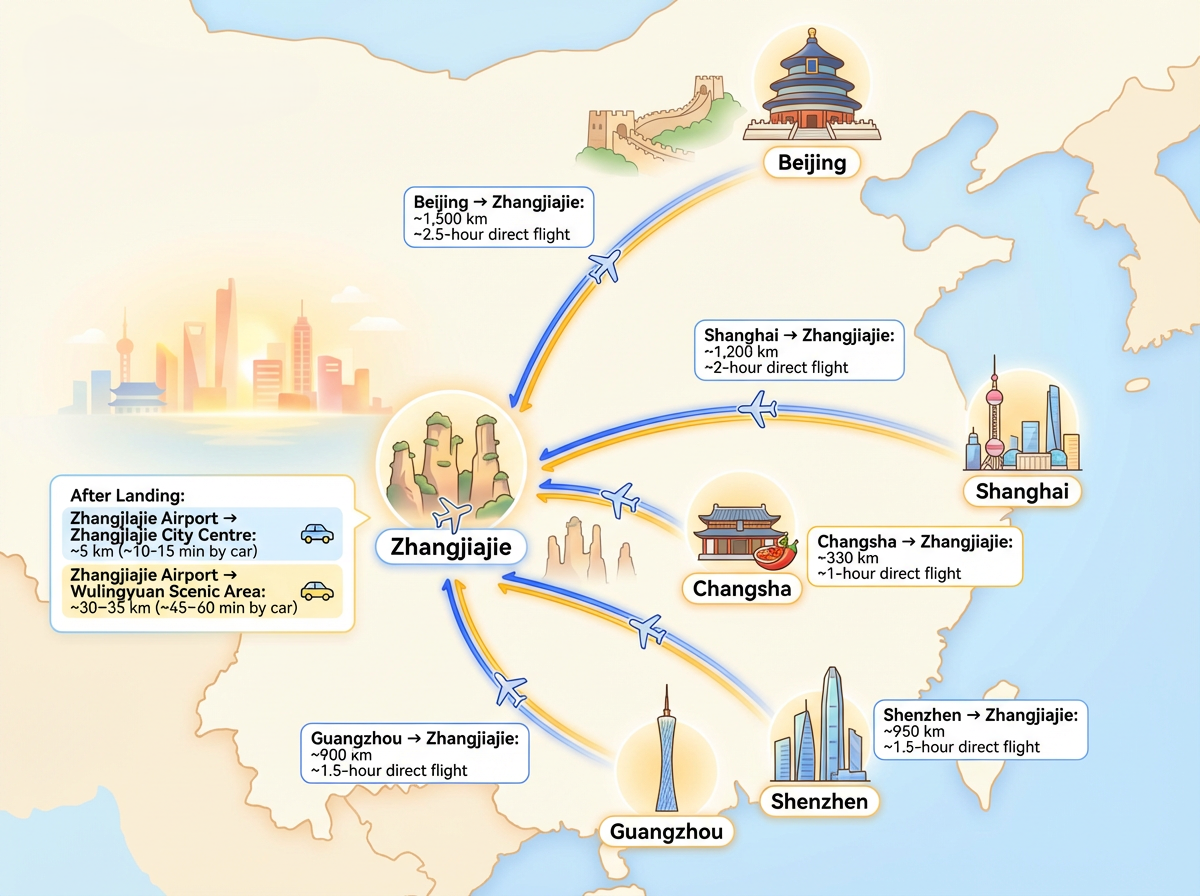
 

The Flight Reality (Nobody Tells You This)


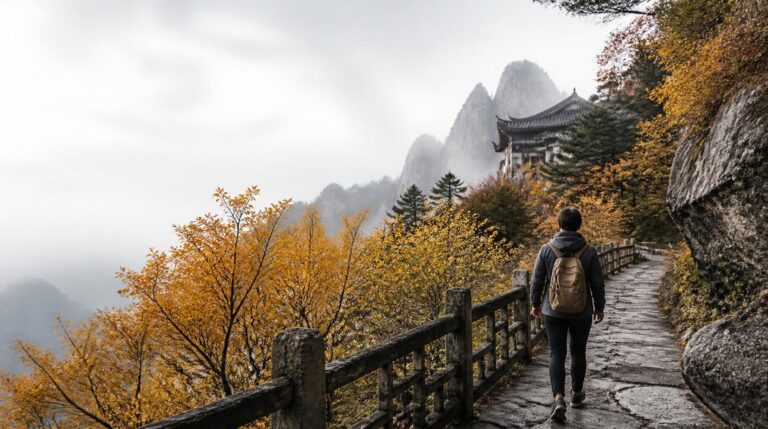
Avatar Mountains In Zhangjiajie: How To Visit China’s “floating Mountains” (best Viewpoints + Tours)

Beijing to Tokyo flight: 3.5 hours flight time + 2 hours airport time each side = 5.5 hours actual elapsed time. Easy connection if you’re flying international.

Shanghai to Tokyo flight: 2 hours flight time + same airport overhead = 4.5 hours elapsed. Easiest domestic-to-international hop in Asia.

Flight cost: 150−300one−wayifbookedinadvance(3−4monthsahead).Last−minute:150-300 one-way if booked in advance (3-4 months ahead). Last-minute: 400-600.

The catch: Overnight flights (red-eye) feel glamorous but destroy your next day. You’ll lose a full day to jet lag after each flight.

Pro tip: Book flights during off-hours. A 10 p.m. departure from Shanghai means you arrive Tokyo around 7 a.m. next day, sleep during your hotel check-in window, wake refreshed around 2 p.m., and have an afternoon/evening to adjust. Way better than losing a midday flight to jet lag.
 

How to Book This Without Losing Your Mind


Tour In Western Sichuan: Bipenggou, Xiling Snow Mountain & Ethnic Villages


Option 1: Book separate components

  • China tour through YellowBirdTour (they handle China logistics)
  • Japan tour through a Japan specialist
  • Flights separately through Kayak or Skyscanner
  • Con: Three different booking systems, no single point of contact if something breaks
  • Pro: Maximum flexibility, better prices often

Option 2: Book combined package

  • Some tour companies offer China-Japan combos
  • YellowBirdTour handles both countries and can coordinate
  • Con: Less flexible, sometimes more expensive
  • Pro: Single contact, coordinated transfers, one payment

Recommendation: Use Option 1 if you’re flexible and want to save money. Use Option 2 if you want stress-free logistics.


The Daily Rhythm That Works


Group of international tourists walking along the Summer Palace lake in Beijing


China and Japan have completely different paces. Smashing them together means constant gear-shifting.

In China, your day:

  • 6-7 a.m. wake (jet lag natural)
  • 7-8 a.m. breakfast (breakfast culture is strong)
  • 8 a.m.-12 p.m. major activity (museums, temples, sites)
  • 12-2 p.m. long lunch (food stops, rest)
  • 2-5 p.m. light activity or rest
  • 5-6 p.m. dinner (early, accommodates kids/elderly)
  • 6-7 p.m. back to hotel
  • 7+ p.m. free time (bar, local exploration, sleep)

In Japan, your day:

  • 6-7 a.m. wake
  • 7-8 a.m. breakfast (smaller, quick)
  • 8 a.m.-12 p.m. temples, shrines, neighborhoods
  • 12-1 p.m. lunch (quick, standing often)
  • 1-5 p.m. continued sightseeing (way more walking than China)
  • 5-6 p.m. dinner (late by China standards)
  • 6-8 p.m. continued exploration
  • 8+ p.m. free time

The adjustment: Japan requires more walking and energy. China is more bus/car based with longer rest periods. When you transition from China to Japan, expect the pace to feel faster and more tiring. Build in an extra rest day in Japan if possible.
 

Food: The Major Transition


4 Days Beijing City Tour | Group Tour: Tiananmen Square, Forbidden City, Summer Palace

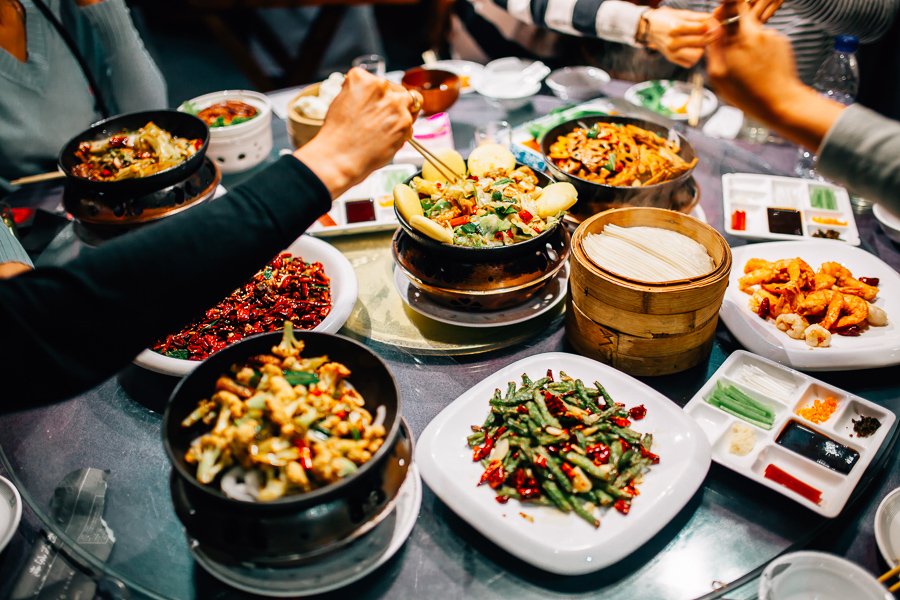
In China, you’ll eat rich, spicy, varied food. Chili oil, fish sauce, hotpot, bold flavors. Your palate adjusts.

In Japan, food is refined, precise, sometimes subtle. Umami over heat. Portion control. Respect for ingredients.

The adjustment period: Your stomach needs 2-3 days to switch between systems. This is totally normal and not a sign of illness.

Pro tip: In your final 2 days in China, start eating milder versions of foods. Steamed dumplings over fried. Less spice. It eases the transition.


What to Actually See (The Highlights That Matter)

Must-See in China:

Beijing (non-negotiable):

  • Great Wall (Mutianyu section, cable car up/down = 4 hours total)
  • Forbidden City (honestly can be rushed in 2 hours)
  • Summer Palace (gorgeous, 3 hours)
  • Tiananmen Square (free, huge, overwhelming)

Secondary cities (pick one or two):

  • Xi’an for Terracotta Army (half-day, could do as day trip from Beijing)
  • Chengdu for pandas (must-do if you like animals, 3 hours at research base)
  • Shanghai for modern contrast (actually interesting for 2-3 days)

Time allocation: 4 days Beijing minimum. Add 2-3 days for secondary city. Total: 6-7 days minimum for China to not feel rushed.

Must-See in Japan:

Tokyo (non-negotiable):

  • Shibuya Crossing (15 minutes, do it at night)
  • Senso-ji Temple (1-2 hours, early morning to avoid crowds)
  • Meiji Shrine (easy, peaceful, 1 hour)
  • Shinjuku for energy (walk around, 2-3 hours)

Kyoto (strongly recommended):

  • Arashiyama Bamboo Grove (early morning only, 1 hour)
  • Fushimi Inari Shrine (thousands of red gates, 2-3 hours)
  • Kinkaku-ji (Golden Pavilion, beautiful but crowded, 1 hour)
  • Gion district (geisha spotting possible at dusk, walk around 2-3 hours)

Bullet train between cities: One 2.5-hour train ride from Tokyo to Kyoto is worth it.

Time allocation: 3 days Tokyo, 2 days Kyoto/Nara minimum. Total: 5-7 days for Japan to not feel tourist-rushed.


China Travel Tour Packages: Your Guide To Unforgettable China Vacations

Visa and Documentation Reality

China visa:

30 day visa-free travel to China for citizens of:

France | Germany | Italy | Spain | Netherlands | Switzerland | Ireland | Austria | Belgium | Luxembourg | Poland | Portugal | Greece | Hungary | Norway | Finland | Denmark | Iceland | Sweden (from Nov 10, 2025) | Monaco | Andorra | Liechtenstein | Bulgaria | Romania | Croatia | Montenegro | North Macedonia | Malta | Estonia | Latvia | Cyprus | Slovenia | Slovakia | New Zealand | Australia | Brazil | Argentina | Chile | Peru | Uruguay | South Korea | Japan | Saudi Arabia | Oman | Kuwait | Bahrain | Thailand | Malaysia | Singapore | Maldives | Kazakhstan | Armenia | Georgia | UAE | Barbados | Bahamas | Belarus | Bosnia and Herzegovina | Dominica | Fiji | Grenada | Qatar | Mauritius | Serbia | Seychelles | San Marino | Suriname | Tonga | Uzbekistan | Azerbaijan | Brunei | Russia | UK

Japan visa:

Most Western nationals get 90-day visa-free entry on arrival. No advance application needed. Just show your passport.

The Budget Reality (For Real)

14-day combo (mid-range) per person:

  • International flights: $1,200-1,800
  • China tour (8 days): $1,000-1,500
  • Japan tour (5 days): $1,200-1,800
  • Flights between countries: $250-400
  • Food outside tours: $500-800
  • Miscellaneous: $300-500

Total: $4,500-7,200 per person

That’s $320-514 per day all-in. Doable. Not budget, not luxury.

Money hack: Book tours as group tours (not private guides). You’ll save 30-40% and kids on tours make it more fun.


The Travel Agent Question (When to Use One)


Local guide meeting international travelers at an airport in China and helping with luggage

Travel agents for Japan exist because Japan is confusing logistically for first-timers. Multi-country trips amplify that confusion.

Use a travel agent if:

  • You have less than 2 months to plan
  • You’re unfamiliar with Asia
  • You want someone handling unexpected issues (flight delays, tour changes)
  • You don’t speak English well enough to navigate bookings

Don’t use one if:

  • You’re comfortable with digital systems
  • You have 3+ months to plan
  • You prefer total control over itinerary

YellowBirdTour recommendation: They specialize in Asia logistics and can coordinate China and Japan pieces. One contact for two countries beats three.


When to Go (Seasonal Breakdown)

Spring (March-May):

  • Cherry blossoms in Japan (late March-early April, gorgeous but crowded)
  • Weather in China: perfect
  • Crowds: moderate to high
  • Recommendation: Ideal if you time Japan correctly

Summer (June-August):

  • Weather: hot and humid in both
  • Crowds: maximum
  • Air quality in China: varies
  • Recommendation: Skip unless forced

Fall (September-November):

  • Weather: perfect in both countries
  • Crowds: moderate
  • Colors in Japan: starting (late Oct-Nov)
  • Air quality in China: best
  • Recommendation: Best window for combined trips

Winter (December-February):

  • China: cold, occasional pollution
  • Japan: cool, sunny, dry
  • Crowds: lower
  • Recommendation: Fine if you like cool weather, skip pollution season in China


The 14-Day Sample Itinerary (Concrete Version)

For people who want a literal day-by-day:

Days 1-4: Beijing

  • Day 1: Arrive, settle, rest, explore hotel neighborhood
  • Day 2: Great Wall day tour (Mutianyu)
  • Day 3: Forbidden City, Tiananmen Square, Summer Palace
  • Day 4: Light morning (maybe hutong rickshaw tour), prep for travel

Days 5-7: Xi’an or Chengdu

  • Flight Beijing to Xi’an (2 hours) or Chengdu (3 hours)
  • Day 5: Arrive, rest
  • Day 6: Terracotta Army museum and excavation OR Chengdu panda base
  • Day 7: Local cultural experience, return to Beijing flight

Days 8-10: Shanghai

  • Flight Xi’an/Chengdu to Shanghai (4-5 hours)
  • Day 8: Arrive, explore Bund, rest
  • Day 9: Shanghai Museum, Yu Garden, Pudong district
  • Day 10: Overnight flight Shanghai to Tokyo (depart 10 p.m.)

Days 11-12: Tokyo

  • Day 11: Arrive 7 a.m., check in hotel, rest till afternoon, explore neighborhood
  • Day 12: Shibuya, Shinjuku, Senso-ji Temple, Meiji Shrine

Days 13-14: Kyoto

  • Day 13: Bullet train Tokyo-Kyoto morning, afternoon exploration, Arashiyama
  • Day 14: Fushimi Inari, Kinkaku-ji, Gion district

Day 15: Return to Tokyo, rest, fly home if evening flight


Common Mistakes (Avoid These)

Mistake 1: Not accounting for flight time as lost time
People think a 3-hour flight means 3 hours of lost day. It’s actually 5-6 hours when you include airports. Don’t schedule something important 2 hours after you arrive.

Mistake 2: Too much destination variety
Beijing + Xi’an + Shanghai + Tokyo + Kyoto = 5 cities in 14 days. You’re on a train or plane every other day. Not worth it. Stick to 3-4 cities max.

Mistake 3: Expecting seamless transitions
China and Japan operate completely differently. Expect 1-2 days of adjustment when you arrive in Japan. That’s normal.

Mistake 4: Underestimating Japan’s walking
You’ll walk 15-20 km per day in Japan easily. Comfortable shoes are non-negotiable.

Mistake 5: Not budgeting for flights between countries
People forget the international flight between Shanghai and Tokyo costs $250-400. That’s real money when budgeting.


Complementary Reading from YellowBirdTour

Before booking, read these articles on YellowBirdTour’s site for deeper context:

China and Japan: Best Guided Packages, Prices & Tips 2026 gives pricing breakdowns and pre-made combo packages.

Travel Agent for Japan: What They Do & How to Choose explains when professional help is worth the cost.

Explore Japan: Best Cities breaks down which Japanese cities actually deserve your time.


Book Your Combined Adventure

Ready to do this?

Contact YellowBirdTour for China-Japan package coordination: They can handle the entire logistics chain, book both countries, coordinate flights, and give you a single contact if anything changes.

Direct contact:


They speak both countries’ logistics inside and out. Let them handle the complexity. You handle the adventure.

Leave a Reply

Your email address will not be published. We only use it to notify you about replies and new comments. Required fields *


Explore the World with YellowbirdTour! Share this page with friends and fellow adventurers eager to discover new and exciting tours across Asia and beyond

WhatsApp
Facebook
Telegram
Reddit
Email
X
LinkedIn
Pinterest
Tumblr

Other blogs

//
Need help? Our expert support is available for all your tour and booking needs. Message us on WhatsApp for instant travel support.
Hi there! 👋 How can we assist you with your Asia travel plans today?
Cropped-noun-parrot-739612.png

Play Yellowbird Travel Match and let destiny choose your trip

Sometimes the best journey is the one you didn’t plan.
Just 3 quick questions to reveal your surprise Asia tour.

We’ll use your answers to suggest a real Asia tour that fits you. We never share your email or track your behavior.

Enquiry & Booking

Join a Small Group China and Japan in One Trip: The Smart Way to Combine Both Countries in 2026-2027

Number of travelers