 English

Travel through Asia
China in September & October 2026: Golden Week, Weather & Best Places
⚠ China autumn travel alert: September–October 2026 China has two major public holiday periods coming
 EnglishEnglish
If you’ve searched “what travel advisory level is China” and want a direct answer before reading any further:
The U.S. Department of State currently rates China at Level 2: Exercise Increased Caution.
This advisory was last updated in November 2024 and remains in effect as of April 2026.
Level 2 is the second-lowest of four possible ratings. It does not mean “do not travel” — and it does not mean China is considered dangerous for the average tourist. Millions of international visitors travel to China safely every year.
What it does mean is that certain specific risks exist that travelers should be aware of before they go — primarily related to arbitrary law enforcement, surveillance, and specific risks for dual nationals and business travelers.
Read on for the full breakdown of what this means, which countries have issued what advice, and — crucially — what it means for your actual trip.
The U.S. State Department uses a four-level system to classify travel risk for every country in the world:
| Level | Rating | What It Means |
|---|---|---|
| Level 1 | Exercise Normal Precautions | Lowest risk. Standard travel recommended. |
| Level 2 | Exercise Increased Caution | Some risks present. Be aware and take precautions. |
| Level 3 | Reconsider Travel | Significant risks. Weigh carefully before going. |
| Level 4 | Do Not Travel | Highest risk. Government strongly advises against travel. |
China is at Level 2 — the same level as many popular travel destinations that no one would consider dangerous for tourists. To put it in perspective, countries like France, Germany, and Japan have at various points held Level 2 advisories due to terrorism awareness or specific regional risks. A Level 2 does not mean a destination is unsafe — it means informed, prepared travelers should take note of specific risks.
For reference, Level 4 “Do Not Travel” ratings are reserved for active war zones and countries with extreme political instability. China is nowhere near that category.
Source: U.S. Department of State — travel.state.gov
Current level: Level 2 — Exercise Increased Caution
Last updated: November 2024 (in effect as of April 2026)
The State Department’s specific concerns for China fall into several categories:
Chinese authorities have detained foreign nationals — including U.S. citizens — on national security grounds, sometimes without clear explanation or formal charges. Exit bans have been imposed on some individuals, preventing them from leaving the country while investigations proceed.
Who this primarily affects: Business travelers, journalists, academics, NGO workers, and individuals with dual U.S.-Chinese nationality. This concern is specifically related to the political and legal environment, not tourist activity.
Who this rarely affects: Standard leisure tourists visiting cities, historical sites, and natural landmarks on guided tours.
China maintains an extensive surveillance infrastructure — CCTV cameras, facial recognition, digital monitoring. Foreign nationals may be subject to monitoring of their communications and activities.
Practical implication: For the average tourist, this is more of a privacy consideration than a safety risk. The same infrastructure that monitors locals is present throughout the country.
U.S. citizens who are also Chinese nationals may be treated as Chinese citizens by Chinese authorities, which limits the ability of the U.S. Embassy to provide consular assistance. This is a specific and serious concern for this group.
The State Department notes heightened restrictions and surveillance in specific regions. Tibet and Xinjiang require additional permits for foreign visitors beyond a standard China visa. Hong Kong has a separate advisory noting reduced freedoms since 2020.
Important: The concerns listed above are real and should be taken seriously — but they apply unevenly. The overwhelming majority of tourists traveling to Beijing, Shanghai, Xi’an, Chengdu, Guilin, and other major tourist destinations experience no issues related to these advisories.
Source: UK Foreign, Commonwealth & Development Office — gov.uk/foreign-travel-advice/china
Current status: The FCDO advises British nationals to travel with awareness of specific risks but does not advise against travel to mainland China overall.
Key points from the FCDO guidance relevant to 2026:
The FCDO’s overall position for mainland China (excluding Tibet, Xinjiang, and Hong Kong) is that travel is possible with appropriate awareness — not that travel should be avoided.
Different governments assess risk differently and communicate it through their own systems. Here is a summary as of April 2026:
| Country | Issuing Body | Current Advice for China |
|---|---|---|
| 🇺🇸 United States | U.S. State Department | Level 2 — Exercise Increased Caution |
| 🇬🇧 United Kingdom | FCDO | Travel with awareness; no blanket advice against travel to mainland China |
| 🇦🇺 Australia | DFAT — Smartraveller | Exercise a high degree of caution |
| 🇨🇦 Canada | Global Affairs Canada | Exercise a high degree of caution |
| 🇳🇿 New Zealand | SafeTravel NZ | Exercise increased caution |
⚠️ Important note: Advisory language and levels vary by government. Always check your own country’s official travel advisory directly before booking. Advisories can change — sometimes quickly — in response to diplomatic or political developments. Links to official sources are listed in the FAQ section below.

This is the question that matters most for people planning a trip to China — and the answer is more nuanced than most advisory summaries suggest.
The specific risks cited in the Level 2 advisory — arbitrary detention, exit bans, harassment of dual nationals — are overwhelmingly concentrated in:
Standard tourists visiting the Great Wall, the Terracotta Warriors, Guilin’s karst landscapes, Shanghai’s Bund, or Chengdu’s panda reserves are not the target of these measures. China’s tourism industry is a strategic priority for the Chinese government — visitors are welcomed and generally treated with hospitality.
If you are traveling to China for business — particularly in technology, media, finance, or any sector with geopolitical sensitivity — the Level 2 advisory warrants careful attention. Consult your company’s legal and security teams before travel.
If you hold dual U.S.-Chinese (or other country-Chinese) nationality, read the full State Department and FCDO guidance carefully. Chinese authorities may not recognize your foreign citizenship, and consular access can be severely limited in detention situations.
Foreign journalists and academics researching politically sensitive topics face elevated risk of monitoring, document seizure, and in some cases detention. This is a documented pattern — not a theoretical concern.
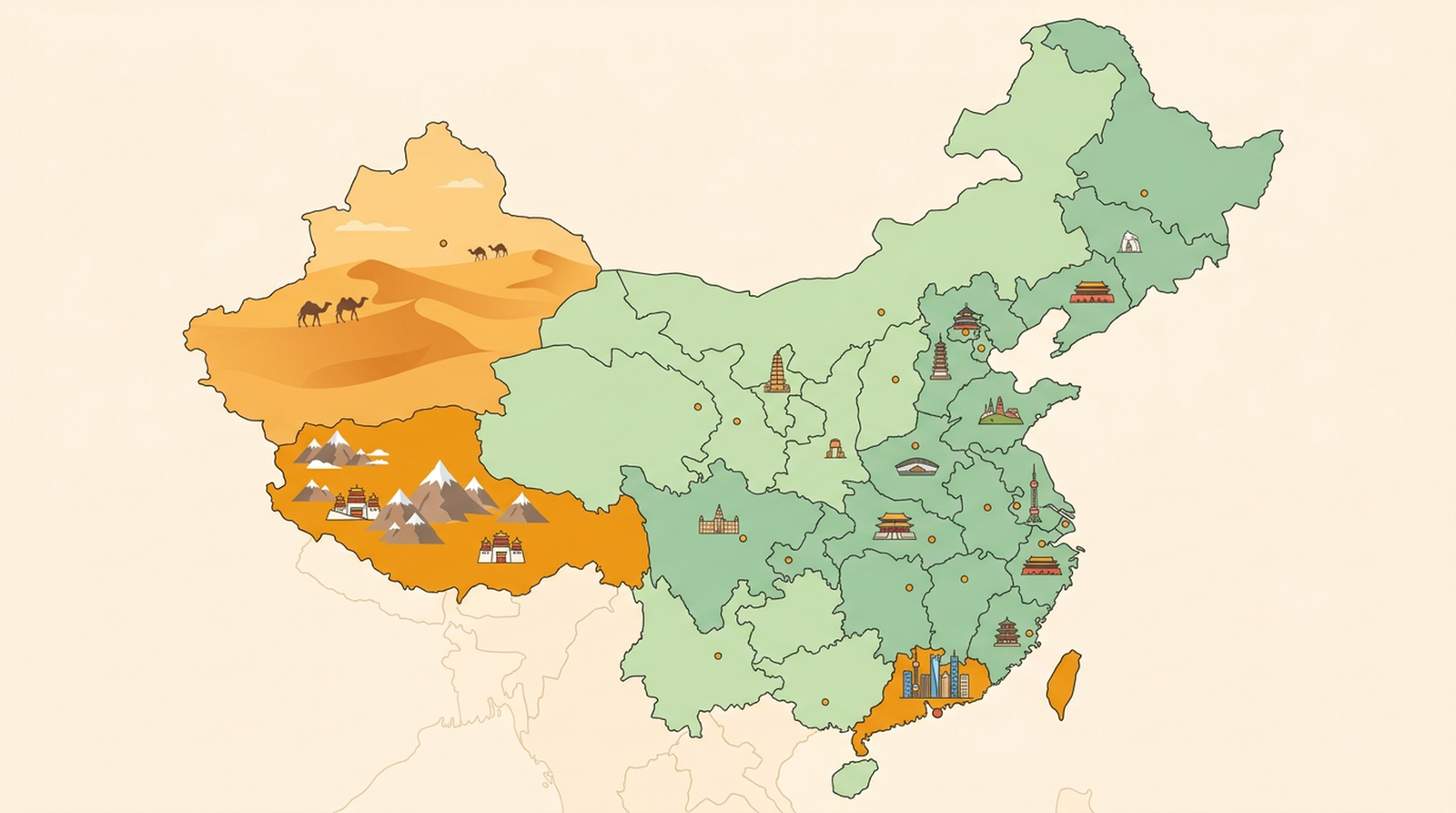
The Level 2 advisory applies to mainland China broadly, but several specific regions have additional layers of caution:
Tibet is not freely accessible to foreign tourists. You need a Tibet Travel Permit in addition to your China visa, which must be arranged through a licensed tour operator. Independent travel is not permitted. The permit system is strict — plan ahead.
Looking for a guided Tibet tour with permit arrangements handled? Browse Tibet tours on YellowBird →
Xinjiang has the most intensive surveillance infrastructure in China. Foreign visitors are permitted but should expect heightened security checks, document inspections, and monitoring. Some governments advise their citizens to exercise extra caution specifically in this region.
Hong Kong operates under a separate advisory from most governments following the 2020 National Security Law. The FCDO and U.S. State Department both maintain separate, dedicated guidance for Hong Kong. It is technically a Special Administrative Region, not subject to the same rules as mainland China.
Beijing, Shanghai, Xi’an, Chengdu, Guilin, Hangzhou, Chongqing, Harbin, and other major tourist destinations fall under the standard Level 2 advisory. No additional restrictions beyond the general guidance apply to these cities.

One of the most significant practical developments for travelers to China in 2026 is the dramatic expansion of visa-free access — which runs somewhat counter to what a travel advisory alone might suggest about the country’s openness to tourism.
China has been progressively expanding the list of nationalities eligible for visa-free entry. As of early 2026:
⚠️ Always verify your specific nationality’s current visa requirements directly with the Chinese Embassy in your country or your government’s official travel advisory. Visa policies can change, and the information above reflects what was publicly confirmed as of April 2026.

The expansion of visa-free access signals China’s strong interest in attracting international tourism — which is broadly positive context for understanding the Level 2 advisory. The advisory reflects specific political and legal risks; the visa-free expansion reflects China’s active effort to welcome travelers.
Both things are true at the same time.
A Level 2 advisory is not a reason to cancel your trip to China. It is a reason to travel prepared. Here is what experienced China travelers recommend:
For a full city-by-city safety breakdown and current alerts, read our comprehensive guide: Is It Safe to Travel to China? Safety Guide, Alerts & Top Tours
A: As of April 2026, the U.S. Department of State rates China at Level 2: Exercise Increased Caution. This advisory has been in place since 2019 and was last updated in November 2024. It is not a “do not travel” warning.
A: For the vast majority of leisure tourists — particularly those visiting major cities like Beijing, Shanghai, Xi’an, Chengdu, and Guilin on organised tours — China is safe to visit. The Level 2 advisory primarily references risks for dual nationals, business travelers, and journalists. Millions of tourists visit China safely each year. Read our full safety guide: Is It Safe to Travel to China?
A: The U.S. State Department advisory was last formally updated in November 2024 and remains at Level 2 as of April 2026. The most significant practical change in 2026 is the expansion of visa-free entry for multiple nationalities, including UK and Canadian citizens.
A: No — the advisory level and visa requirements are separate systems managed by different government departments. In fact, China has expanded visa-free access for many nationalities in 2025–2026, even while the advisory level remains at Level 2.
A: Contact your country’s embassy immediately. U.S. Embassy Beijing: +86-10-8531-4000. UK Embassy Beijing: +86-10-5192-4000. Having comprehensive travel insurance is essential — see our guide: Travel Insurance for China: Essential Coverage
A: Always check your own government’s official source:
China’s Level 2: Exercise Increased Caution travel advisory reflects real and documented risks — primarily for dual nationals, business travelers, journalists, and those with legal exposure in China. For the average leisure tourist exploring China’s extraordinary cities, landscapes, and cultural heritage, the advisory is important context — not a reason to stay home.
Travel informed. Get the right insurance. Register with your embassy. Travel with a reputable local operator.
Browse guided China tours from YellowBird Tour →
Read: Is It Safe to Travel to China? →
Read: Travel Insurance for China — Essential Coverage →
⚠ China autumn travel alert: September–October 2026 China has two major public holiday periods coming

Explore the Silk Road and Qinghai Lake. Uncover ancient history, vibrant cultures, and breathtaking scenery. Begin your unforgettable journey now!

Can you visit Shaolin Temple and Longmen Grottoes on the same trip? Absolutely. Both are

Qinghai Lake or Chaka Salt Lake? If you’re planning a trip through northwest China, you’ve

The China trip cost question is the one everyone Googles before booking, and almost nobody

Introduction: Major News for International Travelers Great news for globetrotters! China has just announced a